An EU regulation on administrative procedure in the forge

25280107859_24c1ba6d6a_o

by Sophie Perez Fernandes, Junior Editor

The EU still lacks a coherent and comprehensive set of codified rules of administrative law, especially of administrative procedural law. Without prejudice to a number of provisions scattered in the Treaties, the applicable rules are mainly enshrined in EU secondary law and are therefore essentially sectoral in scope. The gradual inclusion of procedural rules alongside the substantive regulation of a given subject has thus contributed to the fragmentation of the applicable rules, which affects the coherence of the standards of interpretation and control applicable to the exercise of administrative functions within the EU and its accessibility from the point of view of individuals. In light of the “almost silence” of EU primary law and of the predominantly sectoral nature of EU secondary law, the case-law of the ECJ was soon revealed and continues to be an essential source of general principles of constitutional and administrative law within the EU legal order.

The debate on the codification of fundamental principles of administrative law and basic rules of administrative procedure to be observed in the application of EU law began in the 1980’s and has been fueled by the development of the EU’s fields of competence and successive enlargements. The debate has known a knew impetus since the entry into force of the Treaty of Lisbon due to the addition of Article 298 TFEU according to which «[in] carrying out their missions, the institutions, bodies, offices and agencies of the Union shall have the support of an open, efficient and independent European administration», to which end the European Parliament and the Council shall establish provisions «acting by means of regulations in accordance with the ordinary legislative procedure». The inclusion of a «right to good administration» in the CFREU also feeds the debate. Article 41 CFREU has been pointed out as serving as a starting point or guideline for such codification. As such, the adoption of a regulation/codification of administrative procedure by the EU would serve the dual purpose of promoting open, effective and independent administration (Article 298 TFEU) and protecting the rights of individuals in their relations with it (Article 41 CFREU).

Continue reading “An EU regulation on administrative procedure in the forge”
Editorial of December 2016

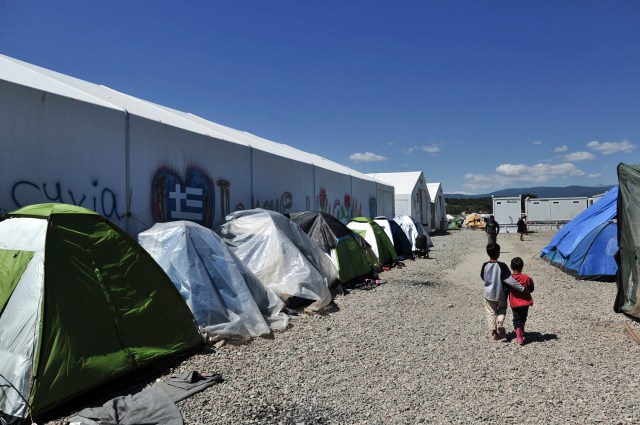
European Parliament in Greece on May 18, 2016

by Mariana Canotilho, Editor
 ▪

‘Listen! Your brother’s blood cries out to me from the ground’

The 6th EASO Consultative Forum Plenary took place in Athens on 28-29 November 2016. I took part in it, as an academic, interested in EU law, and a volunteer working with refugees. A feeling of deep frustration seemed to be shared by most of the attendants (academics, NGO’s workers, EU and UN agencies’ representatives). What is being done is not enough. It is too slow, too bureaucratic; the legal framework is either insufficient or absurd and counterproductive.

EASO is the European Asylum Support Office. It plays a central role in the implementation of the EU Migration agenda and the new hotspot approach. It is the European agency more focused on the specific problems of refugees, trying to strengthen the practical cooperation among Member States on the many aspects of asylum, and providing practical and technical support to Member States and the European Commission, especially to those whose asylum and reception systems are under particular pressure.

However, it can only do so much. The meagre means don’t help, but neither does the competence set, nor the legal framework being applied. The most worrisome feature, repeatedly questioned by NGOs, UN agencies and volunteers is the ‘safe country of origin’ criteria. As part of the European Agenda on Migration, the Commission proposed on 9 September 2015 to establish a common EU list of safe countries of origin that would enable fast-tracking of asylum applications from citizens of these countries, which are considered ‘safe’ according to the criteria set out in the Asylum Procedures Directive and in full compliance with the principle of non-refoulement. This might seem a reasonable idea. However, the criteria are so strict, that countries like Turkey and Afghanistan are considered safe based on their ‘stable democratic system and compliance with international human‐rights treaties’. As this does not stop people from fleeing war and human rights violations, it only aggravates the problems, creating a group of ‘second-class refugees’, who cannot even apply to the relocation mechanism.

Continue reading “Editorial of December 2016”

R (Miller) v The Secretary of State for Exiting the European Union [2016] EWHC 2768 (Admin) : Realpolitik and the Revocation of an Article 50 TEU Notification to Withdraw

2967309821_46aa519072_o

by John Cotter, Senior Lecturer at University of Wolverhampton Law School

The opening lines of a judgment – in common law jurisdictions, at least – can very often be revealing of a court’s concerns. The first five paragraphs of the collegiate High Court judgment (Lord Thomas CJ, Sir Terence Etherton MR and Sales LJ) in Miller indicate very clearly the judges’ worry that their judgment would be misunderstood by sections of the media and the wider public. This judgment did not have “any bearing on the question of the merits or demerits of a withdrawal of the [UK] from the [EU]”, the Court stated. Rather, the question before the Court was a narrow constitutional issue, and a purely legal matter: whether the government could use Royal prerogative powers to give notification of withdrawal from the EU pursuant to Article 50 TEU or whether this was a matter for the Houses of Parliament. On this question, the High Court ruled that the notification under Article 50 TEU may not be given by means of Royal prerogative; rather, such notification is a matter for Parliament exclusively. While the conducting of international relations and the signing of and withdrawal from international treaties were powers generally to be exercised by the executive on behalf of the Crown, the High Court reasoned that where withdrawal from a treaty would result in changes to domestic law (as withdrawal from the EU would), such withdrawal could not be effected without Parliament.

The Court’s attempt to avoid misinterpretation of its role appears, however, to have fallen on deaf or wilfully closed ears, with the judges being subjected to attacks in sections of the media that were astonishing even by the standards of Britain’s rather histrionic tabloid press (one publication’s front page contained the headline “Enemies of the People” along with photographs of the three judges). To many of those advocating Brexit, the judgment was an unelected court playing politics and frustrating the will of the people (even though the European Union Referendum Act 2015 had not provided that the referendum result be binding). To the Court’s defenders, the judgment was the latest in a line of rulings in which the courts upheld the supremacy of Parliament over Royal prerogative powers. It is certainly the case that the High Court judgment, if upheld by the Supreme Court (which is due to hear an appeal in early December), has the potential to make the giving of the Article 50 notification a more lengthy and complex process. It is conceivable that both Houses of Parliament could use their leverage to require the government to reveal more detail on their post-notification negotiating aims. However, as a matter of realpolitik, the judgment is unlikely prevent Article 50 being triggered: Labour, the largest opposition party in the Commons has indicated that it will not vote against a Bill to give notification under Article 50, and it is unlikely that the Lords would provoke further questions about their relevance in modern Britain by blocking Brexit.

Continue reading “R (Miller) v The Secretary of State for Exiting the European Union [2016] EWHC 2768 (Admin) : Realpolitik and the Revocation of an Article 50 TEU Notification to Withdraw”

The need of tax harmonization within the wealth taxation in the European Union

euro-76019_1920

by Hugo Flores da Silva, Assistant Professor at Law School of UMinho


1. Introduction and wealth taxation characterization

Though widely used in the European Union, the wealth taxes account for a relatively small part of the EU Member States’ tax revenue, when compared with the main sources of revenue[i]. At the same time, the political debate and the scientific research developed in the field of wealth taxation is very incipient, when compared to another taxation bases[ii]. Not even the fact that this kind of taxation constitutes one of the oldest ways employed by the states to obtain revenue was able to counter the identified trend[iii].

However, in the current time of fiscal consolidation and macroeconomic adjustment, taxation of wealth is gaining momentum. The lack of alternatives capable of generating an increase in tax revenue within the income and consumption taxation[iv], the growing interest in the fairness and redistributions aspects of the tax system[v] and the need to adjust the tax system to make it more growth friendly[vi], can be pointed out as the main reasons for the recent academic and political debate on wealth taxation.

When we talk about wealth taxation we’re referring to a very complex reality, capable of reunite a very large group of different taxes[vii]. Although there are many types of wealth taxes, and with very different characterization between them, we consider that they can be grouped into two major categories[viii]: taxes on wealth transfers; and taxes on wealth itself. Inside these two main categories it is possible to identify a wide variety of distinct taxes.

The taxes on wealth transfers usually assume the following characterization[ix]: (i) taxes on onerous transfers – as the onerous movable transfers are subject to VAT, in this subcategory we include the taxes levied on onerous immovable transfers[x]; (ii) and taxes on gratuitous transfers – in this subcategory we include the inheritance and gift taxation[xi]. The taxes on wealth itself can be classified as follows[xii]: (i) taxes levied on the holding or ownership of specific assets – usually immovable property[xiii]; and (ii) taxes levied on the taxpayer’s aggregate net-wealth[xiv].
Continue reading “The need of tax harmonization within the wealth taxation in the European Union”

Is Europe alone?

by João Alexandre Guimarães, Erasmus student at UMinho

After the US Election and confirmation of Donald Trump as president, the current President Barack Obama visited Europe and raised an issue … Is Europe alone?

In an interview, the EU Commission President Jean-Claude Juncker, said,

“Trump has, among other things, praised Vladimir Putin, questioned the principle of NATO, and suggested creating a database of Muslims in America.[…] We will need to teach the president-elect what Europe is and how it works,’ he continued, adding that Americans usually had no interest in Europe. […] I think we will waste two years before Mr Trump tours the world he does not know”, via Metro.

In Berlin and after a meeting with Chancellor Angela Merkel, current President Barack Obama recalled the priorities of his eight-year term, saying he hoped that his successor, Donald Trump, would not call into question projects such as the transatlantic free trade agreement or commitments to NATO and the Paris climate deal.

‘‘The committement of the United States to Europe is enduring and it is rooted in the values that we share. The values that Angela just mentioned. Our commitment to democracy, our commitment to the rule of law, our commitment to the dignity of all people. In our own countries and around the world our alliance with our NATO partners has been a cornerstone of US foreign policy for nearly 70 years, in good times and bad, and through presidents of both parties, because the United States has a fundamental interest in Europe’s stability and security,” he said, via Euronews.

Mark Leonard told the Social Europe that “this will be a tough agenda to adopt – not least because Europe is facing its own brand of populist nationalism. France’s far-right National Front leader, Marine Le Pen, was among the first to congratulate Trump on his victory, and Trump has said that he would put the UK at the front of the queue after Brexit. But even Europe’s most Trump-like leaders will find it harder to defend their national interest if they try to go it alone. To survive in Trump’s world, they should try to make Europe great again.”

EU Citizenship and Protection of Social Rights in the Court of Justice case-law

16400696138_b1067bf5a5_o

by Cinzia Peraro, PhD student in European Union Law at the University of Verona

1. Introduction

This post aims at analysing the fundamental freedom of movement of workers and the protection of social rights in light of the recent EU Court of Justice case-law. The arising question is whether fundamental social rights may assume the same hierarchical level as general principles when a balancing test is exercised within the assessment of compatibility of national measures with EU law.

The definition of EU citizenship and the codification of rights granted to EU citizens are covered by the Treaties, namely by Article 9 TEU, Article 18 ff. TFEU and Chapter V of the EU Charter of Fundamental Rights. EU citizens can freely move across the Union in order to work or look for a job or establish their place of work in one Member State different from the one of origin, where they can enjoy the rights granted by the EU. Indeed, EU citizenship creates rights upon EU citizens and therefore could be defined as a “comunidade de direitos”[i].

Nowadays, the free movement of citizens became a core issue within the debates on present threats and challenges that the EU is facing, amongst which the EU immigration policy that is not only linked to the free movement of persons, but also to the underlying process of integration. In general, a more positive approach should be welcomed when addressing current issues.

2. Free movement of workers

Originally, the four fundamental freedoms were established with the aim of increasing and developing the European internal market and workers were granted rights abroad. The Union offered workers the possibility to move across Member States in order to provide their services or capabilities or establish their place of work. Then, the personal dimension was considered and individual rights were recognised, such as the right to family reunification. Thus, the free movement of workers should not be seen in macroeconomic terms, that is to say linked to the development of the internal market, but rather as a personal freedom to choose the country in which citizens want to work.[ii]

Continue reading “EU Citizenship and Protection of Social Rights in the Court of Justice case-law”

Trump won, and what now for Europe?

by João Alexandre Guimarães, Erasmus student at UMinho

Today, 09/11/2016, we discovered that Republican Donald Trump won the American Election for President. But what does this influence in the European Union?

Deutsche Welle, on its website, has stated that Europeans have had rather disappointing experiences with American presidents. That’s just as true for the relationship with Republican George W. Bush as it is for the one with Democrat Barack Obama.

Erica Chenoweth, an expert on international security policy at the University of Denver, said to DW, “Europe should occupy the top spot on the list of priorities for the next president, because it’s about the most important strategic alliance the United States has”.

Mark Stone, from Sky News, talked to Jeremy Shapiro, the research director at the European Council on Foreign Relations, who stated:

“European governments have a strange degree of confidence that although they certainly don’t want a Trump presidency, they can manage it, because he has said a lot of crazy things on the campaign trail but he probably hasn’t meant most of them and probably won’t be able to implement the rest because of the checks and balances and advisers”, via SkyNews.

Continue reading “Trump won, and what now for Europe?”

Brexit is going to happen, but…

by João Alexandre Guimarães, Erasmus student at UMinho

The New York Times says the British government’s plan for leaving the European Union was thrown into uncertainty on Thursday after the High Court ruled that Parliament must give its approval before the process can begin. “The court’s decision seemed likely to slow — but not halt — the British withdrawal from the bloc, a step approved by nearly 52 percent of voters in a June referendum. Nevertheless, the court’s decision was a significant blow to Prime Minister Theresa May“.

She had planned to begin the legal steps for leaving the European Union by the end of March, and to prepare for the negotiations over Britain’s exit mostly behind closed doors. If the court’s ruling is upheld — the government immediately vowed to appeal — that plan would be thrown into disarray, analysts said.

On CNN (also here), Jane Marrick says, this does not have to expose Britain’s detailed negotiating position with Brussels, but it should allow our democratically elected representatives to scrutinize the broad terms. It will also give the 48% who voted Remain — 16 million people — a voice that under the government’s plans they are currently denied.

Eleanor Garnier, from BBC, said this decision has huge implications, not just on the timing of Brexit but on the terms of Brexit. That’s because it’s given the initiative to those on the Remain side in the House of Commons who, it’s now likely, will argue Article 50 can only be triggered when Parliament is ready and that could mean when they’re happy with the terms of any future deal. Of course, it will be immensely difficult to satisfy and get agreement from all those MPs who voted to remain. Could an early general election be on the cards after all? , via BBC.

Editorial of November 2016

7428617406_aba08cab5d_o

by Alessandra Silveira, Editor
and Sophie Perez Fernandes, Junior Editor

Unveiling the meaning of freedom of religion in the workplace

Two preliminary proceedings are currently pending before the Court of Justice of the European Union (ECJ) concerning the question of religious expression at work. In both cases, Achbita (C-157/15), originated in Belgium, and Bougnaoui (C-188/15), originated in France, the ECJ is called upon to rule on a highly sensitive issue – the wearing of Islamic headscarves (and not the full veil) in the workplace. The questions are fundamentally the following: is a private employer allowed to prohibit a female employee of Muslim faith from wearing a headscarf in the workplace?; is the dismissal of an employee who refuses to comply with such rules restricting the wearing of religious symbols at work unlawful?

It is the first time that the ECJ is called upon to address such questions. In the meantime, both AG Kokott (in Achbita) and AG Sharpston (in Bougnaoui) have rendered their opinions. The issues raised in both cases require the interpretation of the concept of ‘discrimination on the grounds of religion or belief’ within the meaning of the Anti-Discrimination Directive – the Directive 2000/78[i]. Both Advocates General concluded that a ban, such as those at issue in the main proceedings, could be regarded as indirect discrimination: the rules in question, although apparently neutral, were likely to put individuals of certain religions or beliefs at a particular disadvantage by comparison with other employees. Such discrimination may nevertheless be permitted if i) objectively justified by a legitimate aim, such as the interest of the employer’s business to enforce a policy of religious and ideological neutrality, and ii) so far as the principle of proportionality is observed (Article 2/2/b of Directive 2000/78).

However, the Advocates General disagree as to whether such a ban could be found as constituting direct discrimination (Article 2/2/a of Directive 2000/78). According to AG Kokott, a ban such as that at issue in Achbita could not be regarded as direct discrimination based on religion: a company rule prohibiting the wearing of visible signs of religious, political or philosophical beliefs, only creates a difference of treatment between employees who wish to give active expression to a particular belief and their colleagues who do not feel the same need. Thus, Ms Achbita had not been treated less favourably than another person on account of religion directly and specifically. On the contrary, AG Sharpston firstly concluded that Ms Bougnaoui’s dismissal amounted to direct discrimination against her on the basis of her religion as the right to manifest one’s religion is to be understood as an intrinsic part of the right to freedom of religion enshrined in both Article 9 of the European Convention of Human Rights (ECHR) and Article 10 of the Charter of Fundamental Rights of the European Union (CFREU). The distinction between direct and indirect discrimination is relevant as their possible justifications are different. In her analysis, AG Sharpston concluded that neither Article 4(1) of Directive 2000/78, nor any of the other derogations from the prohibition of direct discrimination on grounds of religion which that directive lays down, applied.

Continue reading “Editorial of November 2016”

On the CJEU’s post-Brexit case-law on European citizenship. The recovery of the identity Ariadne’s thread?

23896739209_9e171a11d9_o

by Professor Alessandra Silveira, Editor

The CJEU over the years has helped forging a concept of citizenship directed to be the “fundamental status of Member States nationals”. However, since the ruling Dereci of 2011, the proactivity of the CJEU concerning the development of the European citizenship seemed to have gradually exhausted its potentialities, mostly on the so-called social citizenship. It happens, tough, that the crucial moment the European Union faces demands the enhancement of its vertical relation with the citizens it upholds – it is either this or fragmentation. And maybe this is the subliminal message from the CJEU in three post-Brexit rulings that, decided in the Grand Chamber, surprisingly recover and develop the most emblematic case-law about the European citizenship – namely the Rottmann[i] and Zambrano[ii] rulings – whose political potential and/or identity potential seemed irrevocably muzzled.

In the ruling Rendón Marín[iii] and CS[iv], the core issue involved the expulsion and the automatic refusal of the concession of residence to third states nationals who have a dependent minor European citizen – in  both cases due to the parent’s criminal records. The CJEU recovered the Zambrano assertion, according to which Article 20, TFEU precludes national provisions that have the effect of depriving citizens of the Union of the genuine enjoyment of the substance of the rights conferred by virtue of their status as citizens of the Union[v] and, in this sense, it must be attributed the derived right of residence to the national from a third State, under this risk of the useful effect of the European citizenship being affected, if the minor is forced to leave the territory of the Union to follow his/her parent[vi]. In both rulings, the novelty is the way the CJEU appreciates, in the light of the fundamental rights of the European citizen, the possibility of a Member State to introduce limits to such derived right of residence which arises from Article 20, TFEU.

Continue reading “On the CJEU’s post-Brexit case-law on European citizenship. The recovery of the identity Ariadne’s thread?”