Eurogroup and secrecy

8466751401_5c1212cd98_o

by Andreia Barbosa, PhD student at the Law School of UMinho

It is clear from Article 1 of Protocol No 14, annexed to the Treaty on the Functioning of the European Union, that Eurogroup meetings take place informally.

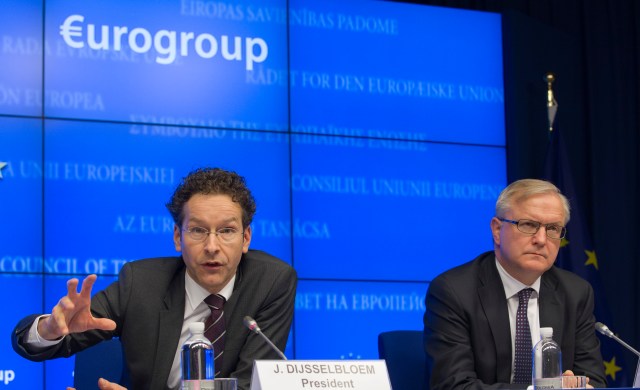
Informality is reflected in two aspects. First, according to the terms in which the meetings are held, that is, as to the procedure adopted therein. In fact, there is no set of rules defining the procedure to be followed, for example, to ensure the involvement of all actors and to determine the order in which such interventions can be carried out and the duration they may have. Secondly, the terms in which «decisions» are taken and how they are made known to the public. It is through press conferences that the outcome of the meetings is presented to citizens of the Union (and when they are).

It should be noted that we refer to «decisions» as a result of Eurogroup meetings, even though we know that the formal, final, and binding decision on the subject is actually taken at the Ecofin meeting. However, we are also aware of the fact that the votes made at Ecofin express the outcome of the previous Eurogroup meeting. The final decision of Ecofin was born in the Eurogroup.

So, the informality resulting from Article 1 of Protocol No 14 actually means «opacity». Contrary to the idea of necessary transparency and publicity in all decision-making centers, no minutes or documents are signed in the Eurogroup, there are no transcripts or records relating to the respective meetings. No database has ever been set up to add up the «decisions» taken. The proposals under discussion, the presented votes, the conflicts of interest that have arisen and the commitments made are not known. Moreover, the acts of the Eurogroup can not be syndicated before the Court of Justice of the European Union, even though they are not documented, neither on paper nor in audio or video.

Although a certain procedural informality is admitted (but still susceptible of criticism), it does not seem to admit an opacity in the decisions. In abstract, a procedure can be informal and simultaneously transparent. In particular, the functioning of the Eurogroup may be informal, but its «decisions» should not be opaque. And the lack of transparency that exists goes beyond mere confidentiality.

Continue reading “Eurogroup and secrecy”

Lost in the Nacional Parliament’s Hallways: The Directive 2005/36/EC and the difficult path until its proper application in Portugal

aaaaaaaaa

by Rita de Sousa Costa, law student at UMinho
and Tiago Sérgio Cabral, law student at UMinho

The precedence of EU law over the law of the Member States is one of the fundamental principles of the Union. The Member States must comply with the European dispositions and shall not issue legislation contradicting EU law. To do so would be a breach of the principle of loyalty (art. 4(3) TEU). However, the states do not always legislate with the proper rigour and responsibility and when this occurs the principle of direct effect is key to assure a uniform application of the European Law and the protection of the European citizens.  In this short essay we shall study how the Portuguese legislator after correctly implementing the Directive 2005/36/EC of the European Parliament and of the Council of 7 September 2005 on the recognition of professional qualifications (through the Law n. 9/2009, of 4th March) proceeded to change the Portuguese legal framework (through the Law n. 31/2009, of 3rd July[i]) putting our law in direct contradiction with the Directive and how the solution, still in force, came in the form of the direct application of the Directive’s provisions.

Introduction – The Legal Framework

The Directive establishes the rules  “according to which a Member State which makes access to or pursuit of a regulated profession in its territory contingent upon possession of specific professional qualifications (…) shall recognise professional qualifications obtained in one or more other Member States (referred to hereinafter as the home Member State) and which allow the holder of the said qualifications to pursue the same profession there, for access to and pursuit of that profession”.

Continue reading “Lost in the Nacional Parliament’s Hallways: The Directive 2005/36/EC and the difficult path until its proper application in Portugal”

Brexit, The Supreme Court (UK) and the principle of loyalty: on the question of irrevocability of a withdrawal notice

Supreme Court December 2016 - 01

by Alessandra Silveira, Editor

Article 50, TEU is silent on several issues concerning the withdrawal of a Member State from the European Union. Such article establishes that the Member State shall notify the European Council of its withdrawal intention in accordance with its own constitutional requirements. But it does not provide for, for instance, about the hypothesis of revoking the notification of the withdrawal intention, perhaps – before the certainty of revocability – to prevent the Member States of being tempted to influence the destiny of the EU through a false threat of exit. Therefore the doubts raised by article 50, TEU will have to be solved in the light of the principles of the EU law, in special the principle of loyalty [Article 4(3), TEU]. According to this principle of friendly conduct, inherent to all known federative systems, the EU and the Member States respect and assist each other mutually in the fulfilment of the missions resulting from the Treaties.

In 24 January 2017, The Supreme Court issued its expected ruling on whether a notice withdrawing the UK from the EU Treaties can, under the UK’s constitutional arrangements, lawfully be given by Government ministers without prior authorisation by an Act of Parliament.[i] Probably to justify the absence of a reference for a preliminary ruling on the question of irrevocability of a withdrawal notice pursuant to Article 50 TEU, The Supreme Court  highlights that UK’s constitutional requirements are a matter of domestic law should be determined by UK judges. Moreover, The Supreme Court asserted that the issues in those appeals have nothing to do with political issues such as the merits of the decision to withdraw, the timetable and terms of so doing, or the details of any future relationship between the UK and the EU.

Continue reading “Brexit, The Supreme Court (UK) and the principle of loyalty: on the question of irrevocability of a withdrawal notice”

The concept of (economic) sovereignty: the Apple/Ireland case

by Ana Filipa Afonseca, student of the Master´s degree in EU Law of UMinho

If we know the economic policy behind the article 107.º and 108.º of TFEU we will know better ourselves as European Union. Here, the sovereinty have a modern aproach because it deals with a new reallity, witch is the heart of EU: the idea of a single, free and fair market throught the Member States. That necessarilly increases a deep discussion about the institutional and Member State’s power to take attractive measures to grow up their own economy throught tax benefits, such as the case in analysis.

But, in fact, the Member States are now new states because they are regulated by common politics emerged by a supra national organ, which did not exist: the EU itself. When we say “new States” we are not calling for a conceptual reform in the international law as the elements of the 1st article of Montevideo’s Convention remain. It must be noted that the requirement of an effective Government does not take into account the way/fashion in which state policy is implemented but, symbolically, it is important to point out that there is a new set of rules that inevitably transform the path of State economic policy in the Member States of the EU.

In this way, if every competition rule in the TFEU as well as the economic freedoms ones are important to the new economic formula, the prohibition of State aid under Article 107 and 108 has an added symbolic force: it is addressed directly to the Member States, imposing a stand still position before their peers.

Continue reading “The concept of (economic) sovereignty: the Apple/Ireland case”

An EU regulation on administrative procedure in the forge

25280107859_24c1ba6d6a_o

by Sophie Perez Fernandes, Junior Editor

The EU still lacks a coherent and comprehensive set of codified rules of administrative law, especially of administrative procedural law. Without prejudice to a number of provisions scattered in the Treaties, the applicable rules are mainly enshrined in EU secondary law and are therefore essentially sectoral in scope. The gradual inclusion of procedural rules alongside the substantive regulation of a given subject has thus contributed to the fragmentation of the applicable rules, which affects the coherence of the standards of interpretation and control applicable to the exercise of administrative functions within the EU and its accessibility from the point of view of individuals. In light of the “almost silence” of EU primary law and of the predominantly sectoral nature of EU secondary law, the case-law of the ECJ was soon revealed and continues to be an essential source of general principles of constitutional and administrative law within the EU legal order.

The debate on the codification of fundamental principles of administrative law and basic rules of administrative procedure to be observed in the application of EU law began in the 1980’s and has been fueled by the development of the EU’s fields of competence and successive enlargements. The debate has known a knew impetus since the entry into force of the Treaty of Lisbon due to the addition of Article 298 TFEU according to which «[in] carrying out their missions, the institutions, bodies, offices and agencies of the Union shall have the support of an open, efficient and independent European administration», to which end the European Parliament and the Council shall establish provisions «acting by means of regulations in accordance with the ordinary legislative procedure». The inclusion of a «right to good administration» in the CFREU also feeds the debate. Article 41 CFREU has been pointed out as serving as a starting point or guideline for such codification. As such, the adoption of a regulation/codification of administrative procedure by the EU would serve the dual purpose of promoting open, effective and independent administration (Article 298 TFEU) and protecting the rights of individuals in their relations with it (Article 41 CFREU).

Continue reading “An EU regulation on administrative procedure in the forge”

On the CJEU’s post-Brexit case-law on European citizenship. The recovery of the identity Ariadne’s thread?

23896739209_9e171a11d9_o

by Professor Alessandra Silveira, Editor

The CJEU over the years has helped forging a concept of citizenship directed to be the “fundamental status of Member States nationals”. However, since the ruling Dereci of 2011, the proactivity of the CJEU concerning the development of the European citizenship seemed to have gradually exhausted its potentialities, mostly on the so-called social citizenship. It happens, tough, that the crucial moment the European Union faces demands the enhancement of its vertical relation with the citizens it upholds – it is either this or fragmentation. And maybe this is the subliminal message from the CJEU in three post-Brexit rulings that, decided in the Grand Chamber, surprisingly recover and develop the most emblematic case-law about the European citizenship – namely the Rottmann[i] and Zambrano[ii] rulings – whose political potential and/or identity potential seemed irrevocably muzzled.

In the ruling Rendón Marín[iii] and CS[iv], the core issue involved the expulsion and the automatic refusal of the concession of residence to third states nationals who have a dependent minor European citizen – in  both cases due to the parent’s criminal records. The CJEU recovered the Zambrano assertion, according to which Article 20, TFEU precludes national provisions that have the effect of depriving citizens of the Union of the genuine enjoyment of the substance of the rights conferred by virtue of their status as citizens of the Union[v] and, in this sense, it must be attributed the derived right of residence to the national from a third State, under this risk of the useful effect of the European citizenship being affected, if the minor is forced to leave the territory of the Union to follow his/her parent[vi]. In both rulings, the novelty is the way the CJEU appreciates, in the light of the fundamental rights of the European citizen, the possibility of a Member State to introduce limits to such derived right of residence which arises from Article 20, TFEU.

Continue reading “On the CJEU’s post-Brexit case-law on European citizenship. The recovery of the identity Ariadne’s thread?”

Directive (EU) 2016/943 of the European Parliament and of the Council, of 8 June 2016, on the protection of undisclosed know-how and business information (trade secrets) against their unlawful acquisition, use and disclosure – brief analysis

1296612658_c2af37ee29_o

by Ana Margarida Pereira, Collaborating Member of CEDU

The differences in the Member States’ legislation regarding the protection of trade secrets against their unlawful acquisition, use or disclosure, the lack of consistency regarding the civil law remedies available and the differences regarding the treatment to give to a third party who has acquired the trade secret in good faith but subsequently learns that the acquisition derived from a previous unlawful acquisition by another party are some of the reasons that justified European action  regarding the protection of undisclosed know-how and business information (trade secrets).

Such differences were, for many years,  a reason for the fragmentation of the internal market and for the weakening of the overall deterrent effect of the relevant rules applicable. This legal framework lead to a decrease of innovation- related cross-border activity and, naturally, to a decrease of European Union’s intellectual production.  In order to provide rules at Union level regarding the harmonization of the protection of know-how and trade secrets it was necessary to elaborate and publish Directive (EU) 2016/943.

Continue reading “Directive (EU) 2016/943 of the European Parliament and of the Council, of 8 June 2016, on the protection of undisclosed know-how and business information (trade secrets) against their unlawful acquisition, use and disclosure – brief analysis”

The voters have spoken. Brexit it is.

27240041144_423bd7d7dc_b

by Catherine Barnard, Professor of European Union Law 
and the Jean Monnet Chair of EU Law 
in the Faculty of Law at the University of Cambridge

The voters have spoken. Brexit it is.

But what does Brexit in fact mean? Pulling up the drawbridge altogether or entering some special relationship with the EU? One possibility would be adopting EU law-lite, through membership of the European Economic Area. The UK would retain access to the single market but would still have to pay a membership fee and probably accept free movement of persons, at least in a modified form. What about free trade agreements like the one the EU has with Canada (which is not yet ratified)? But what would this mean for the UK’s flourishing services sector? There are some unpalatable choices ahead for politicians to make.

Meanwhile, there are some important constitutional questions to be addressed. What is required to trigger Article 50 TEU, the legal provision for a country to leave the European Union? Can the Prime Minister do it by way of the exercise of her prerogative (inherent) powers or will there need to be an Act of Parliament? This issue is currently being litigated in the British courts.

Once triggered, how long will the negotiation process take? The Article envisages two years, but with the possibility of an extension but only by unanimous agreement. How will the negotiations fit in with the elections in France and Germany when their leaders have their eye on domestic matters? Can the UK civil service, 25% smaller than in 2005, cope with the severe strains that Brexit will put it under? And what about the position of Scotland and Northern Ireland?

The Brexit vote was the easy bit. The hard work is about to begin.

___

Picture credits: ‘Brexit, Polling station sign for the EU referendum vote’, by Ungry Young Man.

Brexit and the European Football Market: The Consequences for the Premier League and the British Players

by Rita de Sousa Costa, law student at UMinho
and Tiago Sérgio Cabral, law student at UMinho

The results of the referendum held in Great Britain on the 23rd of June of 2016 shall certainly change the course of history. On this day “Brexit” trumped “Bremain” by 52% against 48% with a turnout of about 72%. And while the results of the referendum are not binding it does seem that the British government plans to respect the will of the voters.

Leaving the EU will affect not only the economy but every single aspect of the lives of the British people, including sports. The British love sports, mainly football, and Britain, more precisely England has one of most competitive football leagues in the world: the Premier League. Nigel Farage a top UK politician and one of the most prominent leave supporters said in April:

What this referendum is about is taking back control of our lives, our laws and our borders”.

However, we must ask ourselves what are the consequences of “taking back our laws and borders” for the Premier League?

Farage is a supporter of Crystal Palace, whose team is composed of 32 players, and 12 of those players are not British. Manchester United, the winner of the FA Cup, regularly plays with 7 non-British players on its line-up even if in total it has more than 50% British players on its roster. How will the Premier League survive after Brexit? Will its teams agree with Farage’s statement “outside of this single market we will be better off” (here)?
Continue reading “Brexit and the European Football Market: The Consequences for the Premier League and the British Players”

The Regulation on EU trade mark

by Maria Miguel Carvalho, Collaborating Member of CEDU


The creation of a community trade mark law by Regulation (EC) n. 40/94, of 20 December 1993, in parallel with the protection that trade marks can benefit from at the national level, achieved a massive success as over 100.000 community marks were registered per year. This success was enhanced because their acquisition by any person (natural or legal, including public entities) through a single registration procedure before the OHIM was allowed as well as it assured a uniform protection and produced the same effects in all European Economic Area.

However, after more than 20 years of its approval, and notwithstanding the entry into force of Regulation (CE) n. 207/2009, of 26 February 2009, on the Community trade mark (TMR), which repealed the first one, a reform was needed in order to make the register system more accessible and efficient to the companies – reducing costs and complexity and raising rapidness and legal certainty. Such changes took place with the approval of Regulation (EU) 2015/2424 of the European Parliament and the Council, of 16 December 2015.

This Regulation constitutes – in line with the Directive (EU) 2015/2436, of the European Parliament and the Council, of 16 December 2016 – the largest and most important alteration to the European trade mark system, having significantly modified the Regulation (EC) n. 207/2009, of 26 February 2009.

Continue reading “The Regulation on EU trade mark”