Fyodor Dostoyevsky and the primacy of EU law: overcoming the “eternal husband complex”

25095088385_be42a66d92_o

by Alessandra Silveira, Editor

The Arts have always helped the human being to organize the knowledge and to provide a way to understand the meaning of things. The recent decision of the German Constitutional Court[i] on the European Central Bank (ECB) and its Public Sector Purchase Programme (PSPP) has served to create distrust in an atmosphere that is already very sensitive – and it has reminded me an academic episode that shows the role of the Arts in the process of learning. A few years ago, I carefully assessed a paper presented by a Master’s student entitled «Constitutionalism and the principle of primacy of EU law: overcoming the ‘eternal husband complex’». The unexpected title touched on “The Eternal Husband”, Fyodor Dostoyevsky’s literary work. Of course, this needs to be contextualized.

It is said that Russians under czarist rule used to refer in this way, “eternal husband”, to those who never dared to separate from their wives, regardless of the misfortune of the conjugality – from the mere lack of interest to adultery. Adapting the characters to the legal script of integration, the Master’s student explained me his objectives. He wanted to show that the constitutional system of checks and balances which guides the functioning of the EU legal order prevents EU Institutions from betraying the principles that establish and sustain the Member States constitutional paradigm. Therefore, the student argued, there are no credible reasons for resentments and misgivings – and it is urgently required to overcome the “eternal husband complex” of the national constitutionalism.

If we test this argument in light of the concept of European Union as a Union of law, we will conclude that the student may well be right. That legal principle affirms the idea that the Union is based on the rule of law, inasmuch as neither its Member States nor its Institutions can avoid a review of the question whether the measures adopted by them are in conformity with the EU basic constitutional charter – the Constitutive Treaties. Therefore, the principle of primacy of EU law does not qualify each and every EU legal act, but only those issued in accordance with the Constitutive Treaties – and the ECJ is solely responsible for assessing this validity. According to Article 19(1) TUE, the ECJ shall ensure that in the interpretation and application of the Treaties the law is observed, i. e., the ECJ is who decides on the scope and the exercise of the EU competences.
Continue reading “Fyodor Dostoyevsky and the primacy of EU law: overcoming the “eternal husband complex””
1951 and 2020 – On Europe Day

20150220PHT24343_original

by Pedro Madeira Froufe, Editor

What does the year of 1951 have in common with 2020? For now, not much. Given the circumstances we live in, few periods of recent history have anything in common with the strange year of 2020, which closes the first fifth of the 21st century. The pandemic crisis exposed some fragilities and unimaginable weaknesses, until not so long ago, in the construction of our current lives. It is clear that we are still very far away from a conclusive ending to the crisis we are living; it is still too early to draw conclusions of a more philosophical character, or even structuring lessons! Moreover, in times of war, we cannot rest, and it is in some kind of contemporary war (at least relating some of its effects) in which we are currently moving, on a planetary scale. To some extent, we are, indeed, experiencing a type of third world war, with no formal declaration of war!

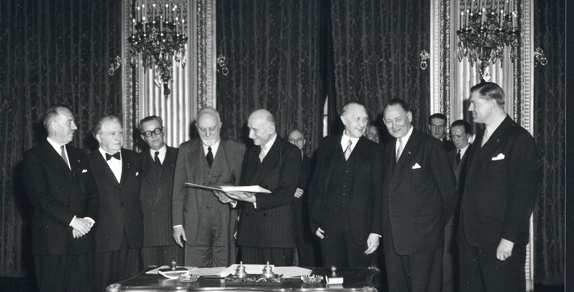
But let us return to the question at stake and place ourselves in the European context, rectius, of the European Union. It is important to remember that the 18th of April this year marked 69 years since France, Italy, the Federal Republic of Germany and the three Benelux states (Belgium, Holland, and Luxemburg) formally signed the European integration papers. The Paris Treaty was signed on the 18th of April of 1951, which established the ECSC (European Coal and Steel Community), leading to the creation of the first common market which, then, covering fundamental raw materials for the so-called “war industry” (coal and steel), emerged loaded with symbolism, but also distrust in the various public opinions of the Member States that founded the project.
Continue reading “1951 and 2020 – On Europe Day”

Editorial of May 2020

hourglass-4666692_1920

by José Igreja Matos, President of the European Association of Judges


“With all due respect, I have no time for this”. The Hungarian Case

1. The Pandemic Crisis in Hungary. Background.

In Hungary, like in many other countries, the Covid19 pandemic and the envisaged measures to prevent its expansion determined the approval of emergency laws.

The Hungarian Government declared the state of danger on 11 March 2020. On that occasion the power to issue decrees in order to suspend the application of certain laws and to take other extraordinary measures was granted for a period of 15 days, except if the Government – on the basis of an authorization from Parliament – decided to extend the effect of the decree. In effect, on 30 March 2020, this extension has been granted by the Parliament on broad terms: “until the endangering situation cease to exist.”

It is now undisputable the absence of any defined time limit for the extensive powers conceded to the national Government.

In the particular case of the functioning of the courts, on 14 March, the Government declared an extraordinary period of judicial vacations. This means that for the duration of judicial vacation, no regular trial hearing should be scheduled except in urgent court cases. Hearings must be held by videoconference. If the personal contact during the hearing is unavoidable a special protocol were applicable for the protection of health.
Continue reading “Editorial of May 2020”

Direct effect, interpretation in conformity and primacy in times of COVID-19 – topic reflexions in an interjurisdictional approach in the EU

bands-paper-red-texture-striping-plastic

 by Joana Abreu, Editor and Jean Monnet Module eUjust Coordinator

Departing from the previous UNIO Blog’s contribution “VAT and customs duties in COVID-19 times in the European Union – do the ends justify all means?”, authored by Andreia Barbosa, some other EU law fundamental questions arose concerning the principle of direct effect and its directions, particularly when it is related to Directives’ rules, and its symbiotic relations with primacy and interpretation in conformity.

The consistent jurisprudence of the ECJ (despite doctrinal criticism on the matter) widely exposed its fundamental requirements when the direct effect of a Directive’s rule is being assessed, i.e., there is a need for it to i) create a right in the individuals’ legal sphere; ii) which has to be stated in clear / precise and unconditioned terms; iii) lacking of concretization’s need by a European or national rule.
Continue reading “Direct effect, interpretation in conformity and primacy in times of COVID-19 – topic reflexions in an interjurisdictional approach in the EU”

VAT and customs duties in COVID-19 times in the European Union – do the ends justify all means?

VAT text on coins

 by Andreia Barbosa, PhD Candidate at the University of Minho

Given the international public health emergency, it is paramount to adopt measures to mitigate the global spread of the virus and its underlying impacts at different levels – including at the international trade level.

The adaptation of the tax regime related to international exchanges of goods has already begun to be made, given the need to facilitate (through the reduction of taxation) the acquisition of equipment for the prevention and combat of COVID-19. The European Commission itself has addressed a note to the General- Directors of Tax and Customs Administrations of the Member States (and the United Kingdom), clarifying what exceptional instruments are available to help disaster victims and which can be used to tackle this health crisis without precedents.

In Portugal, the VAT exemption already enshrined in the transmission of goods free of charge, for later distribution to people in need, made to the Portuguese State agencies or other philanthropic organizations [in accordance with the provisions of in articles 51 to 57 of Council Directive 2009/132/EC of October 19th, 2009, which determines the scope of Article 143 (b) and (c) of Directive 2006/112 / EC], was assumed as an instrument capable of promoting aid to the victims of the COVID-19.
Continue reading “VAT and customs duties in COVID-19 times in the European Union – do the ends justify all means?”

Is the European Union’s legal framework ready for AI-enabled drone deliveries? A preliminary short assessment – from the Commission Implementing Regulation 2019/947/EU to data protection

19793862459_d3350b1a38_o

 by Marília Frias, Senior Associate at Vieira de Almeida & Associados
 and Tiago Cabral, Master in EU Law, University of Minho

1. As we are writing this short essay, a significant percentage of the world population is at home, in isolation, as a preventive measure to stop the spread of the COVID-19 pandemic. Of course, for isolation to be effective, people should only leave their houses, when strictly necessary, for instance, to shop essential goods and, frequently, preventive measures include orders of closure directed to all non-essential businesses.

2. Unfortunately, the European Union (hereinafter, “EU”) is one of the epicentres of the pandemic. As a result, some European citizens are turning to e-commerce to buy goods not available in the brick-and-mortar shops that are still open. Meanwhile, others opt to bring their shopping into the online realm simply to reduce the risk of contact and infection. Currently, sustaining the market as best as possible under these conditions to avoid a (stronger) economic crisis should be one of the key priorities. Furthermore, with a growing number of people working remotely, it is also vital to guarantee that the necessary supplies can arrive in time and with no health-related concerns attached.

3. Nowadays, most delivery services work based on humans who physically get the product from point A and deliver it to point B. The system is more or less the same, whether the reader orders a package from China or delivery from the pizza place 5 minutes away from the reader’s house. Obviously, more people will be involved in the delivery chain in our first example, but it is still, at its core, a string of people getting the order from point A to point B. This is a challenge for those working in the delivery and transportation businesses who have to put their health on the line to ensure swift delivery of products to the ones who are at home.
Continue reading “Is the European Union’s legal framework ready for AI-enabled drone deliveries? A preliminary short assessment – from the Commission Implementing Regulation 2019/947/EU to data protection”

COVID-19 – Nationalism and its toll on citizenship and mobility rights in the European Union

6935020481_4fffffe222_o

 by Patrícia Jerónimo, JusGov, University of Minho

There is still much that we do not know about COVID-19, but by now it has become very clear that, far from being ‘the great equalizer,’ the disease is disproportionately impacting the poor and the most vulnerable (including racial and ethnic minorities), fuelling nationalist and xenophobic sentiments,[i] and prompting a resurgence of borders and mobility restrictions all over the globe. The siege mentality that has been brewing under the threats of mass migration and terrorism is now at peak intensity, as States barricade themselves, adopt increasingly protectionist measures and compete against each other for medical supplies and personnel.[ii]

In Europe, the first national responses to the outbreak were unilateral and selfish, which should come as no surprise to anyone familiar with the European integration process, but is nevertheless disheartening. In early March, when Italy became the epicentre of the outbreak and the WHO acknowledged that we were facing a pandemic, Austria and other Schengen States rushed to reintroduce border controls at their land and air borders, in rapid succession.[iii] Flights to and from Italy were blocked by several EU Member States.[iv] EU citizens were denied admission in Italy, Hungary, Croatia and the Czech Republic, to name a few.[v] The Hungarian government banned the entry of all non-Hungarian citizens, with minor exceptions, and suspended submission of asylum claims.[vi] Cyprus even barred entry to its own nationals returning from hotspots abroad.[vii] Boats of migrants intercepted in the Mediterranean were hastily returned to Libya.[viii] The list could go on.
Continue reading “COVID-19 – Nationalism and its toll on citizenship and mobility rights in the European Union”

Human dignity, child protection and the case C-233-18 (12 of November 2019)

bcadq346754
  by Maria Inês Costa, Master's student in Human Rights at UMinho


The first article of the EU Charter of Fundamental Rights focuses on the preservation of the human being’s dignity. Gomes Canotilho and Vital Moreira highlight that the dignity of the human person is the mainstay of the principle of equality, in the sense that it is not possible to weight or grade “dignities”: it belongs to everyone, not just the “normal” people, but also the disabled, criminals and with “deviations”, not just to national citizens (and Europeans), but also to foreigners, stateless people, refugees and the exiles. This observation presents a vision of human dignity as something that belongs to everyone by virtue of being human, and not due to some exceptional condition. It is a right that is ours, and under no circumstances can it be taken away from us.

Having these ideas present in mind, it is of great relevance to pay attention to the process and conclusions that can be taken from the publishing of the judgement of the EU Court of Justice, written following the case C-233/18, that opposed Zubair Haqbin to Fedasil, the Federal Agency for the reception of asylum seekers, in Belgium.

Zubair, a young minor of Afghan nationality, applied for international protection to the Belgian authorities on 23 December 2015. He was taken to a center in Sugny and Brochem, and he was also appointed a tutor.

Continue reading “Human dignity, child protection and the case C-233-18 (12 of November 2019)”

Summaries of judgments


Summaries of judgments made in collaboration with the Portuguese judges and référendaire of the General Court (Maria José Costeira, Ricardo Silva Passos and Esperança Mealha)
 ▪


Judgment of the General Court (Seventh Chamber) of 12 December 2019 – T‑683/18

EU trade mark – Application for EU figurative mark CANNABIS STORE AMSTERDAM – Absolute ground for refusal – Trade mark contrary to public policy – Article 7(1)(f) of Regulation (EU) 2017/1001 – Article 7(2) of Regulation 2017/1001

1 – Facts

In 2016, Santa Conte, resident in Naples (Italy), filed an application for registration of an EU trade mark for food, drink and restaurant services with the European Union Intellectual Property Office (EUIPO), as reproduced below:

photo

Registration was refused on the basis of Article 7(1)(f) of Regulation No 2017/1001, according to which “shall not be registered (…) trade marks which are contrary to public policy or to accepted principles of morality”.

Disagreeing with this decision, Santa Conte challenged EUIPO’s decision before the General Court of the European Union (GC).
Continue reading “Summaries of judgments”

We are all in the same boat! On the legal principle of solidarity and its legal implications in the recent CJEU case law

5443243347_f20715f9cb_o

by Alessandra Silveira, Editor

The Opinion of the Advocate-General Eleanor Sharpston in the joined cases C-715/17, C‑718/17 and C‑719/17 (delivered on 31 October 2019) concluded by recalling an old story from the Jewish tradition that deserves wider circulation – particularly in times of COVID-19 pandemic. A group of men are travelling together in a boat. Suddenly, one of them takes out an auger and starts to bore a hole in the hull beneath himself. His companions remonstrate with him. ‘Why are you doing that?’ they cry. ‘What are you complaining about?’ says he. ‘Am I not drilling the hole under my own seat?’ ‘Yes,’ they reply, ‘but the water will come in and flood the boat for all of us’ (paragraph 255).

The story is recalled by the Advocate-General regarding the principle of solidarity provided in Article 80 TFEU: “The policies of the Union set out in this Chapter [‘Policies on border checks, asylum and immigration’] and their implementation shall be governed by the principle of solidarity and fair sharing of responsibility, including its financial implications, between the Member States. Wherever necessary, Union acts adopted pursuant to this Chapter shall contain appropriate measures to give effect to this principle”.

On this principle – which requires all Member States – the Advocate-General stated that “respecting the ‘rules of the club’ and playing one’s proper part in solidarity with fellow Europeans cannot be based on a penny-pinching cost-benefit analysis along the lines (familiar, alas, from Brexiteer rhetoric) of ‘what precisely does the EU cost me per week and what exactly do I personally get out of it?’ Such self-centredness is a betrayal of the founding fathers’ vision for a peaceful and prosperous continent. It is the antithesis of being a loyal Member State and being worthy, as an individual, of shared European citizenship. If the European project is to prosper and go forward, we must all do better than that” (paragraph 254 of the Opinion).
Continue reading “We are all in the same boat! On the legal principle of solidarity and its legal implications in the recent CJEU case law”