

Pedro Petiz Viana (Master in Law and Informatics from UMinho / LL.M. in European Law from Leiden University / EU Affairs Advisor in the Portuguese Parliament)
▪
Under Articles 258 and 260(3) of the Treaty on the Functioning of the European Union (TFEU), and in accordance with the principle of sincere cooperation laid down in Article 4(3) of the Treaty on European Union (TEU), Member States have the obligation to notify the European Commission of the national measures transposing a Directive.
As affirmed by the Court of Justice of the European Union, this notification must “contain sufficiently clear and precise information on the substance of the national rules which transpose a Directive”,[1] so that the Commission is in a position to ascertain whether the Member State has genuinely and completely implemented the Directive.[2]
As stated by the Court in Commission v. Belgium, this notification may encompass a “correlation table”.[3] The European Commission, in its “Better Regulation Guidelines” also affirmed that this obligation to communicate may include the so-called “correspondence tables”.[4] [5]
Under Portuguese national law, specifically, under the framework on the organisation and functioning of the XXIII constitutional government,[6] it is established that the transposition of normative acts of the European Union (“EU”) by the Government is accompanied by a table of correspondence between the provisions of the Directive to be transposed and the corresponding national transposition.[7] These transposition tables are drafted by the “Direção Geral de Assuntos Europeus” (Directorate General for European Affairs) belonging to the Ministry of Foreign Affairs.
On the basis of parliamentary requests, the Portuguese government has made public the transposition tables that accompanied the transposition of Directives since the beginning of its mandate.[8] This documentation allows citizens to get a glimpse of how European law is transposed in practice.
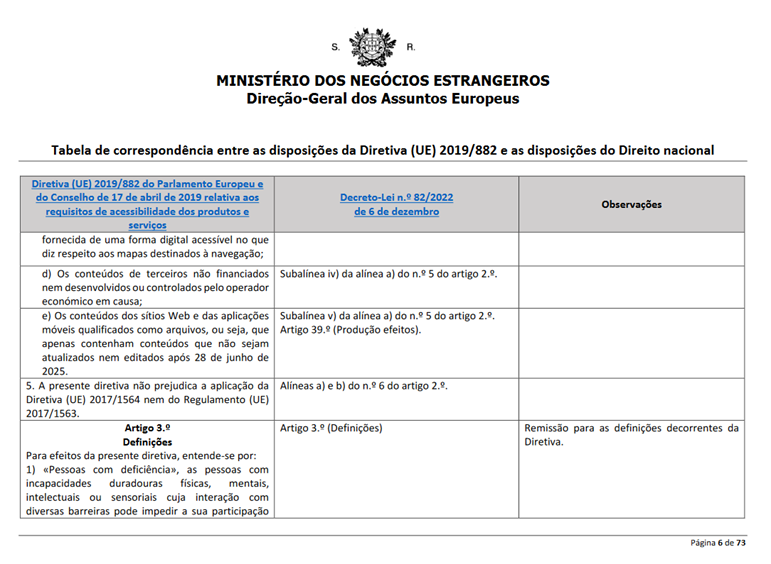
Image 1 – Correlation Table on the Transposition of Directive 2019/882 by the Portuguese Government
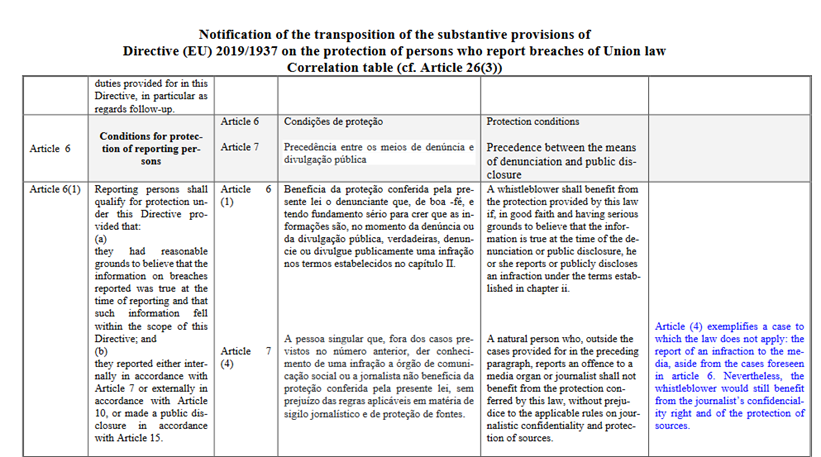
Image 2 – Correlation Table on the Transposition of Directive 2019/1937 by the Portuguese Government
In addition, under its previous legislature, the Portuguese parliament unanimously approved two legislative initiatives (Projeto de Lei n.º 453/XV/1[9] and Projeto de Lei n.º 547/XV/1),[10] which have established that the government shall forward to the parliament these correspondence tables, after they have been communicated to the European Commission under Article 260(3) of the TFEU.
As established under Article 5(1)(m) of Lei n.º 43/2006, de 25 de agosto, as amended by Lei 44/2023, de 14 de agosto,[11] the government is now legally obliged to inform the parliament, under its information duties on European affairs, on the transposition tables concerning EU Directives.
The availability of transposition tables has been repeatedly requested by the European Parliament. In its resolution of 12 April 2016, “Towards better regulation of the Single Market”,[12] the European Parliament affirmed the importance of correspondence tables in monitoring the correct application of European law, calling on Member States to publish them.
In its resolution of 9 July 2008 on the role of the national judge in the European judicial system,[13] the European Parliament had already declared its support for the publication of correlation tables, on the basis that they allow for the availability of “valuable information at minimal cost and expense”, an increase in “transparency in the application of Community law” and “offer national judges and parties to proceedings a reasonable opportunity to verify for themselves whether a particular national provision underlies certain provisions of Community law and, if so, whether it has been transposed in such a way as to ensure that it is in conformity with Community law”.
This legislative initiative by the Portuguese parliament therefore constitutes a positive development for the implementation of EU Law in Portugal.
Portuguese law now allows for a greater transparency in the transposition of EU Directives, with the Assembleia da República now being better equipped to assume its role, as prescribed under Article 12 TEU, to “contribute actively to the good functioning of the Union”.
[1] Commission v Belgium, [2019], ECLI:EU:C:2019:573, Par. 50 and 51.
[2] Commission v Italy, [2005], ECLI:EU:C:2005:388, par. 27.
[3] Commission v Belgium. [2019], ECLI:EU:C:2019:573, Par. 51.
[4] COMMISSION STAFF WORKING DOCUMENT Better Regulation Guidelines, SWD(2021) 305 final, Available at https://data.consilium.europa.eu/doc/document/ST-14004-2021-INIT/en/pdf, page 40.
[5] The expression “correlation table”, “correspondence table” and “transposition table” will be used interchangeably.
[6] Decree-Law no. 32/2022 of May 9, Article 55, no. 5.
[7] “5 – Os projetos de transposição de atos normativos da União Europeia devem ser acompanhados de uma tabela de correspondências entre as disposições da diretiva a transpor e a correspondente transposição nacional.” in Decree-Law no. 32/2022 of May 9, Article 55, no. 5.
[8] https://www.parlamento.pt/ActividadeParlamentar/Paginas/DetalhePerguntaRequerimento.aspx?BID=123758
[9] https://www.parlamento.pt/ActividadeParlamentar/Paginas/DetalheIniciativa.aspx?BID=152208
[10] https://www.parlamento.pt/ActividadeParlamentar/Paginas/DetalheIniciativa.aspx?BID=152418
[11] “m) Tabelas de correspondência relativas aos procedimentos de transposição de diretiva, após a sua comunicação à Comissão Europeia.” in Article 2 of Lei 44/2023, de 14 de agosto, available at https://diariodarepublica.pt/dr/detalhe/lei/44-2023-219915286
[12] European Parliament resolution of 12 April 2016 on Towards improved single market regulation (2015/2089(INI)), https://eur-lex.europa.eu/legal-content/EN/TXT/?uri=CELEX:52016IP0105
[13] European Parliament resolution of 9 July 2008 on the role of the national judge in the European judicial system (2007/2027(INI)), https://www.europarl.europa.eu/doceo/document/TA-6-2008-0352_EN.html.
Picture credits: Mikhail Nilov on Pexels.com.


Pingback: From the Official Journal to the Diário da República: the role of correlation tables and Lei 44/2023 in the transposition of EU Law into Portuguese Law - PolicyModelling.com