Directive (EU) 2016/943 of the European Parliament and of the Council, of 8 June 2016, on the protection of undisclosed know-how and business information (trade secrets) against their unlawful acquisition, use and disclosure – brief analysis

1296612658_c2af37ee29_o

by Ana Margarida Pereira, Collaborating Member of CEDU

The differences in the Member States’ legislation regarding the protection of trade secrets against their unlawful acquisition, use or disclosure, the lack of consistency regarding the civil law remedies available and the differences regarding the treatment to give to a third party who has acquired the trade secret in good faith but subsequently learns that the acquisition derived from a previous unlawful acquisition by another party are some of the reasons that justified European action  regarding the protection of undisclosed know-how and business information (trade secrets).

Such differences were, for many years,  a reason for the fragmentation of the internal market and for the weakening of the overall deterrent effect of the relevant rules applicable. This legal framework lead to a decrease of innovation- related cross-border activity and, naturally, to a decrease of European Union’s intellectual production.  In order to provide rules at Union level regarding the harmonization of the protection of know-how and trade secrets it was necessary to elaborate and publish Directive (EU) 2016/943.

Continue reading “Directive (EU) 2016/943 of the European Parliament and of the Council, of 8 June 2016, on the protection of undisclosed know-how and business information (trade secrets) against their unlawful acquisition, use and disclosure – brief analysis”

Summary of Comission v. Belgium – C-275/83

by José Ricardo Sousa, student of the Master's degree in EU Law of UMinho

Keywords: Social Security; Pensions; Regulation; Resident

Court: CJEU| DateMarch 28th 1983 | Case: C-275/83 | Applicants: European Comission vs Belgium

Summary:  European Comission brought an action pursuant the article 169 of the EEC Treaty against Beligum for disrespect of the obligations under article 33 of regulation n. 1408/71 that involves the application of social security schemes to employed persons and their families. The mentioned article provides that pension’s deductions may be made by an institution of a Member State only for people in these conditions: maternity leave or sickness. However this deductions have to be made by an institution of this Member State wherever could be the actual residence of one persons within the EU. CJEU concluded that the law in force was not comply with the requirements of Community Law.

The decision can be acessed here and the opinion of AG here.

Summary of Cassis Dijon – C-120/78

by José Ricardo Sousa, student of the Master's degree in EU Law of UMinho

Keywords: Common Market; Spirit Drinks, Importation, Minimum Content, Cassis Dijon

Court: CJEU| Date:  Feb. 20th 1979 | Case: C-120/78 | Applicants: Rewe-Zentral AG vs Bundesmonopolverwaltung Für Branntwein

Summary:  Rene-Zentral is a central cooperative undertaking that imports good from other Member States. On 14th September 1976 the company requested authorization for Bundesmonopolverwaltung (Federal Monopoly Administration for Spirits) to import a spirit drink called “Cassis Dijon”. Administration told to Rene-Zentral that there was no need to ask for authorization to import goods, however “Cassis Dijon” couldn’t be sold in Germany because the spirit drink didn’t fulfil the requirements of alcohol (wine-spirits must be around 32% and the mentioned mark had around 20%). Rene claimed that the German provision represented a restriction for the free movement of goods and contrary to article 30 and 37 of the EEC Treaty. Rene brought an action against the decision and the Court suspended the action and referred the following questions to CJEU:

Continue reading “Summary of Cassis Dijon – C-120/78”

Between the competition law and a competition culture: the case of Apple/Ireland

tax-1351881_1280

by Ana Filipa Afonseca, student of the Master´s degree in EU Law of UMinho

The importance of Apple’s case emerged when the journalist of the Irish Times asked the European Commission representative, Margrethe Vestager, in the press conference about the illegality of the aid provided by Ireland to Apple Sales International, if the Union wouldn’t be afraid of losing the investment of external companies with such sanctions. The answer given, without lyricism, made clear that the lesson wasn’t well-examined, after all, she simply answered “this is not a penalty, this is unpaid taxes”. The state aid prohibition read in the 107º TFEU conforms one of the most important competition laws, given that this mechanism contradicts the previous protectionist rules, inherent to the state individualism, in which the national independence was established through favouring State domestic economy to the detriment of other economies. Therefore, this response was surgical: urges the time for the Member States to finally consider the internal market as a single market, defined by the fair competition and this will be the main catch for future investment. Above all, the competition law demands an important shift of thought by the Member States – today we are not one.

The case Apple/Ireland raises several questions. Primarily, it takes into account the mould of the State aid, due to the fact that this is not a direct measure of tax exemption, fiscal guarantee, preferential  tax interest , favourable deals in the land acquisition, special rates, as in most cases, the Irish measure translates in a broad sense, in a advantage (expression used in the Case Italy versus European Commission 2nd of July of 1974, Process 173/73) that benefits the economic operator. The illegal aid converts into splitting of profit between Apple Sales International and Apple Operations Europe which the result implies that the Irish branch office would be subjected to the normal taxation of Irish companies, however, the head office where most of the profit was allocated, was not subjected to any kind of taxation and this was possible under the Irish tax law, which until 2013 allowed for so called ‘Stateless Companies’.

Continue reading “Between the competition law and a competition culture: the case of Apple/Ireland”

Summary of Internationale Handelsgesellschaft – 11/70

by José Ricardo Sousa, student of the Master's degree in EU Law of UMinho

Keywords: Deposit, Export licence, force majeure

Court: CJEU| DateDecember 12nd 1970 | Case: 11/70 | Applicants: Internationale Handelsgesellschaft mbH vs Einfuhr- und Vorratsstelle für Getreide und Futtermittel

Summary:  Internationale Handelsgesellschaft is an import-export undertaking. The company obtained 20 000 metric tons of maize meal with validity until 31st December 1967. According to article 12 of Regulation No 120/67 in what concerns to market of cereals. When the licence expired and the company delivered approximately 11 000 metric tons of cereal. After, Einfuhrund Vorratsstelle für Getreide und Futtermittel declared the deposit forfeited according to Regulation No 473/67/EEC. The undertaking brought an action to court against this decision. The Court suspended the action and sent to CJEU the following questions:

Are the obligation to export, laid down in the third subparagraph of Article 12 (1) of Regulation No 120/67/EEC of the Council of 13 June 1967, the lodging of a deposit, upon which such obligation is made conditional, and forfeiture of the deposit, where exportation is not effected during the period of validity of the export licence, legal? Continue reading “Summary of Internationale Handelsgesellschaft – 11/70”

Summary of Vassen Göbells – C-61/65

by José Ricardo Sousa, student of the Master's degree in EU Law of UMinho

Keywords: Pension, Sickness, Enforceable provisions, Survivors

Court: CJEU| DateDecember 10th 1965 | Case: C-61/65 | Applicants: Mrs Vassen vs Management of the Beambtendfonds voor het Mijnbedrif, Heerlen

Summary: Mrs Vassen was a widow of a mining employer. She was receiving a pension from a pension fund of the social secutrity (BFM), who placed her as a member of a sickness fund. On 31st August 1963 she went to live in Germany. She asked to remove her name from the list, and so the BFM replied saying that her name wasn’t on the list since she went to live in Germany. When Mrs Vassen asked to re-enter on the list, BFM rejected. The Court suspended the works and referred the following question to CJEU:

Is the scheme laid … to be regarded as legislation, as defined in Article 1 (b) of Regulation No 3 and mentioned in Article 4 thereof? Furthermore can the said scheme governing sickness expenses be classified as ‘sickness insurance for mine workers (benefits in cash and in kind in the event of sickness and maternity)’ listed at (i) under the heading ‘Netherlands’ in Annex B to Regulation No 3, to which Article 3 of the said Regulation refers? Thus does Regulation No 3 (and also Regulation No 4) apply to non-manual workers employed in the Netherlands mining industry to whomthe said scheme governing sickness expenses is applicable?
Continue reading “Summary of Vassen Göbells – C-61/65”

Editorial of September 2016

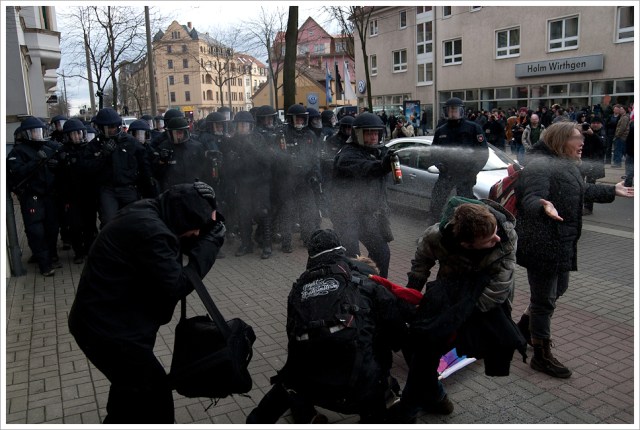
Pepper Police @ Dresden Nazi Frei

by Mariana Canotilho, Editor
 ▪

Democracy at the crossroads

A little over one month ago, the European Commission advanced its disciplinary procedure against Poland, after accusing Warsaw of failing to address concerns over democracy and the rule of law in the country. The Polish government reacted harshly, stating that this is not the kind of presence in the EU they have agreed on, and affirming that the procedure goes beyond the Treaties and the Commission’s competences.

The situation in Poland is serious but it is not unique. Hungary was the precursor in the authoritarian drift. The Tavares report on the country, published in 2013, denounces the weakening of checks and balances, especially the actions against the Constitutional Court, the Parliament and the Data Protection Authority, the undermining of the independence of the judiciary, the restrictions to the rights of persons belonging to minorities and the interference with the media and the right to freedom of opinion and expression.

The Union has strong reasons to fear the dissolution of the rule of law in the East. But the process of re-engagement with it is long, difficult and complex. One of the more obvious difficulties, from a constitutional law point of view, is that the EU’s own track record concerning democracy and the rule of law during the last ‘crisis years’ is at least fuzzy.

The ongoing crisis has been used to contest the steps taken during the last 15 years towards the parliamentarisation of the EU. In fact, there is a remarkable institutional change within the Union – both at national and European levels – promoted in the framework of an ‘emergency politics’ that tends to enhance the powers of executive authorities and of informal, non-accountable, decision mechanisms, in detriment of democratic representative institutions.

Furthermore, the EU has promoted necessity over democratic consent and effectiveness over deliberative reason as decision’s criteria. It has allowed, justified and sometimes even actively furthered the weakening of constitutional mechanisms that control and limit the exercise of power. This has clearly limited the space for well-minded critics, for alternative proposals, for self-reflection and correction of mistakes. Paradoxically, it has also, as the cases of Hungary and Poland sadly demonstrate, opened the floor for the true enemies of European integration and European democratic values. Will the Union still be able – and willing – to save them?

Picture credits: Pepper Police  by MonteCruz Foto.

Summer break

Note by the editors: we will take a short break over the summer and resume blogging in the first week of September.

If you want to catch up on EU matters, consider our

News

Comments

Essays 

Reviews, case notes and  summaries of judgments are also available.

Brexit was highlighted by our latest articles, you can read it by clicking on the link above.

We also invite you to take a look at our call for papers.

Thank you for following our blog!

The voters have spoken. Brexit it is.

27240041144_423bd7d7dc_b

by Catherine Barnard, Professor of European Union Law 
and the Jean Monnet Chair of EU Law 
in the Faculty of Law at the University of Cambridge

The voters have spoken. Brexit it is.

But what does Brexit in fact mean? Pulling up the drawbridge altogether or entering some special relationship with the EU? One possibility would be adopting EU law-lite, through membership of the European Economic Area. The UK would retain access to the single market but would still have to pay a membership fee and probably accept free movement of persons, at least in a modified form. What about free trade agreements like the one the EU has with Canada (which is not yet ratified)? But what would this mean for the UK’s flourishing services sector? There are some unpalatable choices ahead for politicians to make.

Meanwhile, there are some important constitutional questions to be addressed. What is required to trigger Article 50 TEU, the legal provision for a country to leave the European Union? Can the Prime Minister do it by way of the exercise of her prerogative (inherent) powers or will there need to be an Act of Parliament? This issue is currently being litigated in the British courts.

Once triggered, how long will the negotiation process take? The Article envisages two years, but with the possibility of an extension but only by unanimous agreement. How will the negotiations fit in with the elections in France and Germany when their leaders have their eye on domestic matters? Can the UK civil service, 25% smaller than in 2005, cope with the severe strains that Brexit will put it under? And what about the position of Scotland and Northern Ireland?

The Brexit vote was the easy bit. The hard work is about to begin.

___

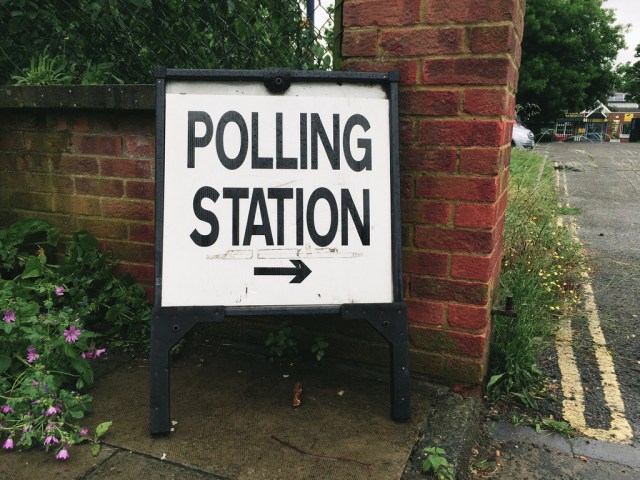
Picture credits: ‘Brexit, Polling station sign for the EU referendum vote’, by Ungry Young Man.

A Perspective on Brexit

27841264756_5d32079576_b

by Elaine Dewhurst, Senior Lecturer in Law, University of Manchester

and Dimitrios Doukas, Reader in Law, University of Manchester

If there are two words that characterise the sentiments of many British-based academics anticipating Brexit, they would be ‘uncertainty’ and ‘sadness’. In the widest sense, there is uncertainty about the future of the EU as a project, and the place of non-British EU citizens living in the United Kingdom. Since the referendum result, the careers and livelihoods of those who benefit from EU research funding and collaboration and/or whose expertise lies predominantly or exclusively in areas of EU law have been marred by fear and doubt. Within the legal profession, for example, UK lawyers face an uphill challenge of seeking admission to a second Bar or Law Society, such as in Ireland, to enable them to continue enjoying the freedom to provide their services within the EU. Within legal academia, there is much speculation surrounding the furtherance of existing research projects, and recent studies suggest that collaborations and funding are at risk of termination as a result of the referendum. In addition, there is uncertainty over whether a post-Brexit Britain will retain a migration stream for academics which would match the free movement principles in terms of its encouragement of cross-border movement. For many, it is not just the professional difficulties that may deter academics from working in Britain. Some also have considered leaving Britain as they fear (or have already experienced) a rise in racism and xenophobia, a problem which may also discourage others from seeking work in Britain. More widely than this, there is fear of increasing and unchecked populist politics and anti-immigrant sentiment in the United Kingdom, an apprehension heightened because of Britain’s unadulterated majoritarian democracy in which EU law with its extensive judicial controls has heretofore performed an enforceable moderating influence. Uncertainty also mars the student experience. British universities have, and continue to, benefit financially and culturally from the many EU students who come to Britain every year to study. Reports suggest that the numbers of EU students applying to British universities has dropped since the referendum, and existing students have had to receive assurances as regards their position. Equally affected by this uncertainty are those British students wishing to participate in Erasmus programmes (a programme which has already benefitted over 200,000 British students).

Continue reading “A Perspective on Brexit”