Editorial of September 2016

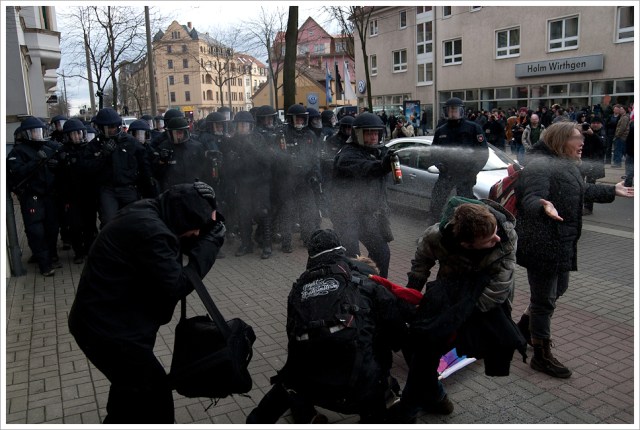
Pepper Police @ Dresden Nazi Frei

by Mariana Canotilho, Editor
 ▪

Democracy at the crossroads

A little over one month ago, the European Commission advanced its disciplinary procedure against Poland, after accusing Warsaw of failing to address concerns over democracy and the rule of law in the country. The Polish government reacted harshly, stating that this is not the kind of presence in the EU they have agreed on, and affirming that the procedure goes beyond the Treaties and the Commission’s competences.

The situation in Poland is serious but it is not unique. Hungary was the precursor in the authoritarian drift. The Tavares report on the country, published in 2013, denounces the weakening of checks and balances, especially the actions against the Constitutional Court, the Parliament and the Data Protection Authority, the undermining of the independence of the judiciary, the restrictions to the rights of persons belonging to minorities and the interference with the media and the right to freedom of opinion and expression.

The Union has strong reasons to fear the dissolution of the rule of law in the East. But the process of re-engagement with it is long, difficult and complex. One of the more obvious difficulties, from a constitutional law point of view, is that the EU’s own track record concerning democracy and the rule of law during the last ‘crisis years’ is at least fuzzy.

The ongoing crisis has been used to contest the steps taken during the last 15 years towards the parliamentarisation of the EU. In fact, there is a remarkable institutional change within the Union – both at national and European levels – promoted in the framework of an ‘emergency politics’ that tends to enhance the powers of executive authorities and of informal, non-accountable, decision mechanisms, in detriment of democratic representative institutions.

Furthermore, the EU has promoted necessity over democratic consent and effectiveness over deliberative reason as decision’s criteria. It has allowed, justified and sometimes even actively furthered the weakening of constitutional mechanisms that control and limit the exercise of power. This has clearly limited the space for well-minded critics, for alternative proposals, for self-reflection and correction of mistakes. Paradoxically, it has also, as the cases of Hungary and Poland sadly demonstrate, opened the floor for the true enemies of European integration and European democratic values. Will the Union still be able – and willing – to save them?

Picture credits: Pepper Police  by MonteCruz Foto.

Sanctions to the anti-trust behaviour: the rethinking

16137090-Business-graph-with-arrow-showing-profits-and-gains-Stock-Photo

by Ana Filipa Afonseca, student of the Master´s degree in EU Law of UMinho

It´s not enough for the conducts to be forbidden. The European legislator’s task is much more compelling and challenging because to the European legislator it’s not enough to say “what can’t be done”, he has to be the creator of a coordinated and coherent system of norms in the Member States. The specificity of the regime created will dictate from where these norms start and where they end up. The anti-trust practices, in a internal market logic, are established in the articles 101, 102 and 106, TFEU as prohibited conducts, prejudicial conducts of a European economic project, which shall be conducive to a strong and developed market. However, the European lawmaker could not apply the same logic of cause, effect and consequence that applies to the traditional national systems once these strike back with the set of rules of the market practice – heir to an era when it was every man for himself.

In fact, the European Union has responded with new mechanisms but they are not consistent with integral efficiency of the competition law, in one hand, because in many cases the heavy fines paid by companies outweigh the profit earned by the anti-trust practice or, in the other hand, in case of abuse of dominant position, after the sanction, it converts itself in a long-lasting dominant position. A calculated risk.

Continue reading “Sanctions to the anti-trust behaviour: the rethinking”

Brexit and the European Football Market: The Consequences for the Premier League and the British Players

by Rita de Sousa Costa, law student at UMinho
and Tiago Sérgio Cabral, law student at UMinho

The results of the referendum held in Great Britain on the 23rd of June of 2016 shall certainly change the course of history. On this day “Brexit” trumped “Bremain” by 52% against 48% with a turnout of about 72%. And while the results of the referendum are not binding it does seem that the British government plans to respect the will of the voters.

Leaving the EU will affect not only the economy but every single aspect of the lives of the British people, including sports. The British love sports, mainly football, and Britain, more precisely England has one of most competitive football leagues in the world: the Premier League. Nigel Farage a top UK politician and one of the most prominent leave supporters said in April:

What this referendum is about is taking back control of our lives, our laws and our borders”.

However, we must ask ourselves what are the consequences of “taking back our laws and borders” for the Premier League?

Farage is a supporter of Crystal Palace, whose team is composed of 32 players, and 12 of those players are not British. Manchester United, the winner of the FA Cup, regularly plays with 7 non-British players on its line-up even if in total it has more than 50% British players on its roster. How will the Premier League survive after Brexit? Will its teams agree with Farage’s statement “outside of this single market we will be better off” (here)?
Continue reading “Brexit and the European Football Market: The Consequences for the Premier League and the British Players”

The Regulation on EU trade mark

by Maria Miguel Carvalho, Collaborating Member of CEDU


The creation of a community trade mark law by Regulation (EC) n. 40/94, of 20 December 1993, in parallel with the protection that trade marks can benefit from at the national level, achieved a massive success as over 100.000 community marks were registered per year. This success was enhanced because their acquisition by any person (natural or legal, including public entities) through a single registration procedure before the OHIM was allowed as well as it assured a uniform protection and produced the same effects in all European Economic Area.

However, after more than 20 years of its approval, and notwithstanding the entry into force of Regulation (CE) n. 207/2009, of 26 February 2009, on the Community trade mark (TMR), which repealed the first one, a reform was needed in order to make the register system more accessible and efficient to the companies – reducing costs and complexity and raising rapidness and legal certainty. Such changes took place with the approval of Regulation (EU) 2015/2424 of the European Parliament and the Council, of 16 December 2015.

This Regulation constitutes – in line with the Directive (EU) 2015/2436, of the European Parliament and the Council, of 16 December 2016 – the largest and most important alteration to the European trade mark system, having significantly modified the Regulation (EC) n. 207/2009, of 26 February 2009.

Continue reading “The Regulation on EU trade mark”

“Out is out” (including in relation to the Mediterranean diet…). On the Article 50 of the European Union Treaty in the light of the federative principle of European loyalty

wine-1176122_960_720

by Professor Alessandra Silveira, Editor

Since Abraham Lincoln faced the hardest constitutional crisis of the USA (War of Secession, 1861-1865) the modern legal theory of federative systems had taken for granted that the hypothesis of secession was repelled. And then the Canadian Supreme Court reframed the data. In the country, in 1995, a referendum was called on the unilateral declaration of secession of Québec. The proposal of separation was reject by a short difference – 50,58% of the votes in a turnout of 94%. Following the referendum the federal government appealed to the Supreme Court to know if a unilateral secession, addressed in a popular consultation not approved by the remaining States, would violate the Constitution. The Supreme Court ruled that a unilateral secession with those features would infringe the Constitution. However, if in a different referendum, when answering a “clear question”, the “clear majority” of the Québécoise casted an unequivocal will of not integrating Canada anymore, then the remaining States and the federal government would be bonded to negotiate with Québec the conditions for its withdrawal because unwritten constitutional principles determined it (Reference re Secession of Quebec, [1998] 2 S.C.R. 217). In the aftermath the federal government passed in the Canadian Parliament “clear” rules tending to regulate and calculate the “price” of withdrawal, especially to safeguard the legitimate interest of the remaining States and their population – as a result, Québec still integrates the federation. Punch line: in a federative system there are neither free lunches nor free exits.

Continue reading ““Out is out” (including in relation to the Mediterranean diet…). On the Article 50 of the European Union Treaty in the light of the federative principle of European loyalty”

Case law Pebros Servizi concerning the European enforcement order for uncontested claims – The enforcement procedure as the next phase… Novelty or reality?


by Joana Covelo de Abreu, Junior Editor
  1. The dispute in the main proceedings

Pebros Servizi sued before an Italian national court several companies and, among them, we could find Aston Martin. However, the latter was duly noticed to present itself in court allowing it to participate in those proceedings, what did not happen. Aston Martin was condemned in absentia to pay to Pebros Servizi the total amount of 18.000,00€ “together with interest at the statutory rate running from the publication of the judgment until payment in full and the legal costs, comprising EUR 835 for sundry expenses and EUR 9 500 for professional fees, plus VAT and other incidental social security expenses under national law”[i].

Aston Martin did not present any appeal and that judgement became final.

On October 2014, Pebros Servizi asked that Italian court to certify that decision as a European enforcement order. However, that court expressed its doubts concerning using Regulation 805/2004 enforcement order in such a case. Those doubts derived from the fact that, in Italian law, a judgment made in default of the defendant does not mean the latter recognises the facts brought against him in the litigation. So, national court had doubts if “a judgment in default [might] be regarded as a judgment for an uncontested claim”[ii]. In this sense, national court called upon two doctrinal positions: 1) One, based on national law, where a default procedure does not amount for an uncontested claim; 2) Another, where “that concept of ‘absence of contestation’ is defined autonomously by EU law and covers also a failure to appear during proceedings”[iii].

Continue reading “Case law Pebros Servizi concerning the European enforcement order for uncontested claims – The enforcement procedure as the next phase… Novelty or reality?”

Conference and call for papers


In 2016 Portugal celebrates 40 years of its Constitution and 30 years of accession to the European Union. In order to join the commemorations and to debate those landmarks, the Centre of Studies in EU Law (CEDU) of University of Minho alongside the Representation of the European Parliament in Portugal distinguish the milestones by promoting the conference “40/30: from the constitutional project to the integration project – hopes, scepticism and reality in a political-constitutional debate” which will be held at the Law School of UMinho on 28th October 2016. The organizers’ partnership intends to perceive the path made upon these 40 years of Portuguese Constitution, 30 of which in interaction with the European project: what was meant originally has or has not been accomplished? Which adaptations, where has it lead us, where are we headed?, questions asked in an intergenerational perspective and in dialogue between scholars and MEPs.

Accompanying the conference, UNIO – EU Law Journal of CEDU issues this call for papers on the theme of the event seeking contributions from EU Law, Constitutional Law, International Law, Political Sciences, etc. for a special edition. The submissions are open until 1st of October.

The Editors and the Board encourage submissions and remind that the editorial policies and processes of UNIO apply.

The conference program will soon be made fully available.

Continue reading “Conference and call for papers”

Editorial of July 2016

brexit-1477615_960_720

by Professor Alessandra Silveira, Editor

Every cloud has a silver lining. On the referendum able to push forward the unity of the Europe and the disunity of the Kingdom

Modern democracy, with which the West has lived since the liberal revolutions, is representative – exceptionally accompanied by moments of semi-direct democracy through referenda or popular consultations. Such exceptionality is based on the very survival of democracy as referenda hardly ever manage to escape high doses of manipulation and abuse. When Hans Kelsen was asked once about the rightfulness of popular consultation, he allegedly answered that, despite they make sense in certain situations, it should not be forgotten that an uninformed population preferred Barabbas over Jesus Christ. This metaphor illustrates one of the main assumptions of the democratic theory (which no one described as brilliantly as Norberto Bobbio): the excess of democracy may kill it.

This becomes crystal clear in the referenda (supposedly) on European issues, tendentiously instrumentalized by national political elites that convert them in arenas to internal disputes. The day the world awaked in astonishment with the results of the British referendum, the top questions at the social networks and search engines in the United Kingdom on the European Union since the Brexit result was officially announced were: “What is the European Union? What does it mean to leave the European Union?” That reveals that many British have voted without really knowing what the EU is or what it stands for in their daily life.

And so 17 million British, deceived by the most despicable demagogy, decided about the destinies of 500 million European, subverting the most elementary democratic rule of a polity – the one of majority will. They did so openly for the worst reasons – fear, hostility, xenophobia, all wrapped in the sovereignty narrative –, offering weapons for the Leftist and Rightist populisms all over Europe to wield a speech against the Brussels’ technocracy. The same technocracy that will stop paying grants to British agriculturists, that will cease supporting research in the British universities, that will discontinue the stimulation for the movement of British Erasmus students, that will interrupt law-making towards promoting equality and non-discrimination among the British.
Continue reading “Editorial of July 2016”

Protecting our personal data in the 21st century: why the new EU legal framework matters

by Rita de Sousa Costa, law student at UMinho
and Tiago Sérgio Cabral, law student at UMinho

Most people do not have any idea of how much the processing of their personal data affects their daily life. In today’s world, our e-mail has the ability to distinguish between important and unimportant e-mails based on our previous communications. When we want to read the news our phones and tablets are able to predict the events and sources that we would be interested in. Facebook knows more about our friends than we do. If you want to watch a movie, Netflix has a broad selection and may give you some tips based on your previously watched list, same with Youtube. If we have a favorite supermarket chain it probably knows what we like to buy through our customer cards. Our keyboards are able to predict the very words we will type[i].

We would find a rather different scenario if we looked to the world in 1995. Twenty years ago, the Internet was still in its early stages of development and was rather different from what we know and use today[ii]. E-mail and instant messaging were unknown to the general population. Google (and search engines as we know them today) did not exist. Social networking and smartphones did, but only in science fiction movies. With this in mind, it is rather astonishing that the EU legal framework regarding the protection of personal data managed to stay, more or less, unchanged for more than twenty years. In these twenty years, the Directive 95/46/CE ensured the protection of personal data for EU citizens fulfilling the required by the Article 16 of the TFUE and the Article 8 of the EUCFR[iii]/[iv].

Continue reading “Protecting our personal data in the 21st century: why the new EU legal framework matters”

On the world of yesterday, witches and ghosts


by Professor Alessandra Silveira, Editor

(text in the memory of Jo Cox, British MP, 41, upholder of refugees’ rights and the continuation of United Kingdom in the EU, who was appallingly killed on 16th June).

Jo Cox’s murder was a senseless attack on democracy itself“, via The Telegraph.

Jo Cox MP death: David Cameron and Jeremy Corbyn unite in tributes“, via BBC.

Jo Cox death: ‘The well of hatred killed her,’ Corbyn says – latest updates“, via The Guardian.

Jo Cox’s tragic death may halt pro-Brexit momentum, analysts say“, via CNBC.

The price of caring“, via The Economist blog.

Jo Cox’s death should make us reflect on our polluted, abusive politics“, via Mirror.

After Jo Cox’s Killing (…)“, via The Wall Street Journal.

Before the adversities we have been facing in Europe lately – financial speculation, migratory boom, terrorism, Euroscepticism, populism, intolerance, Brexit, etc. – sometimes it seems it could not get worse. A sort of perfect storm, as it is said. But it can always get worse. In fact, it was worse in the past. We can acknowledge that by simply reading Stefan Zweig’s memoirs, The World of Yesterday. In it the author gives us a nostalgic picture of a missing world, the one of Europe pre-1914 which is opposed to heinous period of the wars, interleaved by a short time of peace and hope in the European renaissance. It was during the exile in England, and then Brazil, where the Jewish Austrian wrote his memories – as well as the iconic Brazil, land of the future, in deep demonstration of gratitude to the country that hosted him.

At this time of profound consternation due to the harrowing assassination of Jo Cox, this “world of yesterday” described by a war refugee in the end of the 1930s proves that there is still space for a normative approach of the European integration process, inclined to create solutions that help neutralize the fragmentation forces against which the Union is being confronted, and mobilize its cohesion forces.

Continue reading “On the world of yesterday, witches and ghosts”