Editorial of January 2016

OLYMPUS DIGITAL CAMERA

by Mariana Canotilho, Editor
 ▪

‘The inclusion of the other and the fall of the Empire’

The word of the year 2015 was ‘refugee’. It is quite amazing how seven letters can actually encompass the sea of problems the European Union is facing, which will almost certainly be prevalent throughout 2016.

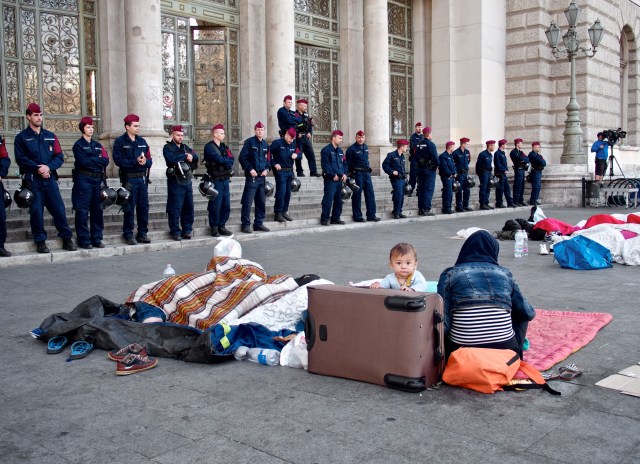
Aylan Kurdi died at our doorstep in the beginning of September. Before him, thousands of other migrants had already drowned in the Mediterranean, but it took the powerful image of a dead child lying on the sand for the Europeans to address the problem. Hundreds of volunteers mobilized to help their fellow humans, who ran away from war and misery. But although individuals acted, according to their possibilities, the EU institutions seem helpless, almost paralyzed. The Union struggled to reach an agreement about the reception and support to the refugees; some Member states refused the proposed quotas’ system. Hungary’s parliament voted to deploy troops to repel refugees from its border, deepening divisions with the rest of the EU. The common mechanisms negotiated have proven almost useless until now. Very few refugees have been resettled. 2016 began with yet another picture of a dead child, while trying to reach safety and peace, and with the alert from the former United Nations High Commissioner for Refugees, António Guterres: the EU has failed, and only traffickers are managing the migrants’ influx.

There is a growing and worrying incapacity, within the Union, to “include the other”, to use a classical expression of J. Habermas. In fact, the refugees’ crisis is only the worst, more serious symptom, of a larger problem: the loss of the European social project, the abandonment of an idea of Europe as an inclusive and plural community of equals. With this phenomenon comes the loss of hope in the Union’s institutions, trapped between the unwillingness of some and the incapacity of others to find reasonable political solutions to people’s problems.

Under this scenario, citizens are turning to other, quite unsettling, options. Extreme right-wing parties are gaining followers and votes all over Europe (France, Hungary and Poland are good examples of this), without a decisive institutional reaction from the EU, even in common matters, and in a striking contrast with the way the Greek crisis was handled.

Nationalism and separatism are rising. No later than 2017, the UK will hold an in-out referendum about the Union. An “out” vote will have unpredictable consequences and may be the end of the European project as we knew it: the “fall of the Empire”. Therefore, the biggest challenge for the time to come is to reinvent the EU. To build European politics based on hope and on values such as solidarity, diversity and rule of law, rather than fear and exclusion. Only Europe can save itself. Will it succeed?

Picture credits: Michael Gubi

[We also invite you to take a look at the Portuguese elections aftermath as commented by Sérgio Maia Tavares Marques, here.]

General Comment – foyer (or Cul-de-sac A Failure Not Worthy Being Called a Failure) [PART 2]

[This is the second part of a comment on the Portuguese elections aftermath, the author will soon provide the final part of this article – PART 3.]
by Sérgio Maia Tavares Marques, Jurist and 
student of the Master's degree in EU Law of UMinho

▪

22794253643_f7c1806a91_o_d


Previously, I have argued that the seeming failure of Portugal for not presenting the draft for the annual budget within the deadline fixed in the TSCG could not be considered a failure. I pointed that the reason for that fact (the delay/failure) was the political negotiation process in the country that it was not yet concluded at that time following a post electoral circumstance never seen before. Days have come and gone and on 26th of November a new Socialist + Leftist parties government took over. Mr. António Costa came to office in replacement of the right wing coalition led by PSD and the former PM, Mr. Pedro Passos Coelho, who had been originally nominated by the President. However, a motion of rejection was voted and approved by the left wing parties altogether and a new cabinet was formed and got in place.

As I underlined, my point was that it was not possible, nor advised for Portugal, to send the European Commission a budget draft when an upcoming administration (with its expenditure priorities) was still unknown. The country could not commit itself to figures that would only be mythical and/or misplaced. Plus and more importantly, I reasoned (in constitutional pluralist terms) that the appointment of a new government, as a direct result of the people´s will expression, can only be considered part of a national identity. In that sense, it falls within the scope of article 4/2 TEU. Therefore, the EU should encourage the demos and not persecute it. Nonetheless, Mr. Valdis Dombrovskis pressured Portugal with possible judicial actions and the situation was put on hold.

Continue reading “General Comment – foyer (or Cul-de-sac A Failure Not Worthy Being Called a Failure) [PART 2]”

EU referendum(s)

Some interesting news on the results of Denmark’s referendum:

PM: Danish Vote Shows ‘Considerable Skepticism’, via The New York Times.

Five burning questions after Denmark’s EU ‘no’, via The Local

And about the possible outcome of the one taking place in the United Kingdom:

David Cameron may be ‘reliant on Labour members in EU referendum’, via The Guardian

‘EU referendum result to be declared in Manchester’, via the BBC.


To read other news that we shared, on highly debated topics in the EU, please click here. You can also share other links that you might find interesting for thinking&debating Europe, in the comments section.

Passing-on of Overcharges: Will the National Courts Lead the Way Forward?

by Vírgilo Mouta Pereira, Jurist and Collaborating Member of CEDU

This article starts by presenting a description of the passing-on regime enshrined in the Damages Directive. It argues that national judges need an effective toolkit to successfully deal with issues relevant to passing-on, thereby contributing to the ultimate goal of the Damages Directive: to help citizens and undertakings to be compensated if they are victims of infringements of the EU Antitrust rules. Against this background, in the years to come, the courts of the EU Member States are expected to play a crucial role.

I – Introduction

The Directive 2014/104/EU on antitrust damages[1] (hereinafter referred to as “Damages Directive”) seeks to help citizens and undertakings to claim compensation it they are victims of a breach of the EU Antitrust rules. Infringements cause concrete harm and the Directive sets out rules to ensure that anyone who has suffered harm caused by a breach of Articles 101 or 102 TFUE can effectively exercise the right to claim full compensation for that harm[2].

Antitrust law infringements causing an overcharge, i.e. a price increase, can harm not only the direct purchasers of the affected goods or services, but also those who afterwards purchased those goods or services. Quantifying the extent to which an overcharge has been passed on is part of a broader framework: the quantification of harm in competition law. Continue reading “Passing-on of Overcharges: Will the National Courts Lead the Way Forward?”

General Comment – foyer (or Cul-de-sac A Failure Not Worthy Being Called a Failure) [PART 1]

[This is the introductory part of a comment on the Portuguese elections aftermath, the author will provide further updated analysis on the topic.]
by Sérgio Maia Tavares Marques, Jurist and 
student of the Master's degree in EU Law of UMinho

Before the third and final beep sounds – which is in theatrical and operistic traditions the last notice for the foyer to be vacated and for seats to be taken – I must briefly point out that my goals with these contributions and this category are not properly rigorous from a scholar vantage point. Academically strict writings are to be found on Reviews and Essays. What we are looking for here on News and Comments is inter alias to encourage free and open debate, a reflection start-up so to speak. So… take your seats and take part!

i) As in every premiere, it seems only suitable to meta-analyse what lies before us. UNIO Blog comes to stage at just the right time to promote academic discussions involving the European Union and its legal/political system throughout society. In the path of the finest European tradition, the Centre of Studies in European Law of University of Minho (CEDU) deserves a project of this kind due to its acclaimed reputation. Research centres of European DNA are known for their critical autonomy and for spreading ideas, for scientific freedom and for intercultural pluralism. Concerning both their agents and their contents. Know this, all readers, authors, partners and critics, such values are in the core of this blog. They move it.
Some of the greatest journals and reviews of the world keep a platform like this one in order to enhance more informal, open and free considerations amongst their collaborators. Unlike the American experience in which it is absolutely and placidly accepted the express and public defence of a certain line, stream or current of thought as well as its interests´ protection to which the think tank adheres, this space is the respectful democratic house of the most diverse scientific-academic theoretical orientations.

ii) Let´s move to the substantial matter of this comment.
The subject has been on the news. Portugal has been seeing a complex election afterwards situation. Not only politically, but also historically and legally/constitutionally. For the first time in 40 years, – that is since democracy was re-established with the dissolution of the Salazarista regime – the winning party is not able to present a stable government proposal. The coalition between right-wing PSD (89 elected members) and CDS (18) does not hold majority in the Parliament and it has failed to accomplish some sort of agreement (by abstention, for instance) with the Socialists (86) and Leftists (19 + 15 + 2). Altogether the latter group can compound an absolute majority to form the government.
Apart from questions concerning the legitimacy of an alliance shaped only after the elections and the anti-EU agenda of leftist parties, the issue that interests us here is the formation of a new government.

Continue reading “General Comment – foyer (or Cul-de-sac A Failure Not Worthy Being Called a Failure) [PART 1]”

Paris attacks – test on EU values or the chance to rebuild a more united and welcoming Union?

Please find bellow some interesting news on the reactions across EU in the aftermath of the Paris attacks that took place on Friday 13, 2015 .

Paris attacks: European leaders link terror threats to immigration, via The Guardian

Europe’s response to the Paris attacks is different this time, via The Economist 

Paris Attacks Shift Europe’s Migrant Focus to Security, via The New York Times

To read other news that we shared, on highly debated topics in the EU, please click here. You can also share other links that you might find interesting for thinking&debating Europe, in the comments section.

Social citizenship: quo vadis? – Inaugural Editorial

by Alessandra Silveira, Editor
and Sophie Perez Fernandes, Junior Editor

The European citizenship as the “the fundamental status of nationals of the Member States”[1] has been shaping the process of integration itself. Unquestionably linked to the protection of fundamental rights, European citizenship has always been focused on the approximation of the legal status of the nationals of Member States, providing the legal base to the eradication of legal gaps of protection and, therefore, contributing to the further development of the integration process. However, recent case law of the ECJ seems to be influenced by the current political-economic dynamics that characterise the current crucial momentum that we are facing, raising perplexity and concern when compared to past rulings which compose the jurisprudential acquis in matters of citizenship and fundamental rights – mainly in what concerns citizens that move in the Union seeking jobs and the maintenance of the status of migrant worker.

The Dano ruling of 2014[2] represents a setback in regard to the previous case law of the ECJ regarding the granting of special non-contributory cash benefits to citizens who are not economically active. Despite the fact that, in this concrete case, a residence certificate of unlimited duration was previously granted to the applicant – a fact apparently disregard by this ruling – the national court considered that the main proceedings concerned persons who could not claim a right of residence in the host State by virtue of Directive 2004/38/CE. The ECJ accompanied the reasoning of the national court stating that the access to social benefits is dependent on the residence in the host Member State as set out by Article 7 of the mentioned Directive – i.e. sufficient economic resources and health insurance[3]. The goal would be to prevent economically inactive citizens from becoming an unreasonable burden on the social assistance system of the host Member State[4], or from using the host Member State’s welfare system to fund their means of subsistence[5]. Admitting otherwise, according to the Court, would go against the objectives of the Directive[6].

Continue reading “Social citizenship: quo vadis? – Inaugural Editorial”